

Google is an ever-changing, updating platform designed to give users the best experience to find what they’re looking for through search, algorithms, and systems, whether that be blog posts, service pages, product pages, and more.
The brains behind Google are never satisfied and always want to add additional quirks, but this can cause SEO experts and businesses trying to implement SEO some trouble if they’re not ready to adapt.
Recently, Google updated E-A-T to E-E-A-T Guidelines, which have been a huge part of the Search Quality Rater Guidelines, and the first-hand experience of a company is becoming more important than ever.
To see what the updated guidelines are and their importance in SEO for you moving forward, that’s what we’ll discuss in this article, so keep reading to learn more!
What Are Google E-E-A-T Guidelines?
In regards to E-E-A-T, this is an acronym that stands for Experience, Expertise, Authoritativeness, and Trustworthiness. Even though E-E-A-T isn’t a direct search ranking factor, if you follow these guidelines and have all the guidelines provided, you’re sure to see better performance as a website.
E-E-A-T is reviewed by Google’s quality raters (human evaluators who assess the quality of web pages and search results), so if you’re a well-known company that is trusted by many with years behind you, you’ll meet these guidelines nicely.
Why is E-E-A-T Important For SEO?
As you look closer at each individual section of E-E-A-T, you can see how having all of these in abundance can create a safety net for the audience.
For example, let’s say you were purchasing a product or service from a business that was experienced, had a high level of expertise, was authoritative within their niche, and was trustworthy – of course, you’d want to buy from that company because you feel safe.
However, no matter if you have experience, expertise, and authoritativeness, you can still get away with not being a trustworthy company in some cases, and that’s why Google says “untrustworthy pages have low E-E-A-T no matter how Experienced, Expert, or Authoritative they may seem.”
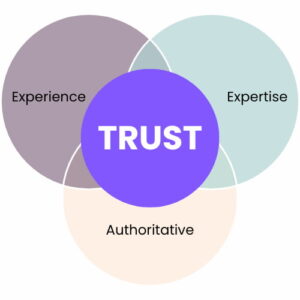
Yet, if you look at E-E-A-T as a whole, it is important for SEO because Google is giving you direct guidelines on what they believe to be high-quality content, and providing users with the most relevant and valuable information.
Therefore, if you uphold Google’s standards and are abiding by their E-E-A-T standards, (regardless of the type of content you’re producing), you’re more than likely on your way to becoming a top brand within your industry.
To make sure you align yourself with Google’s rater guidelines (E-E-A-T), check this out to see their informative blog on the latest updates!
How Google’s Human Quality Evaluators Look at Your E-E-A-T
Google search is an ever-changing platform, as there are always new processes that seem to rank content higher than the rest. However, with SQ rater judgements, these real people evaluating the SERPs daily are always testing for usefulness.
This essentially means that their judgements from the rigorous evaluation process will eventually turn into algorithm updates and drive the new changes within Google’s core updates.
When you look at what Google’s human quality evaluators look for in your web pages on your website to determine whether you abide by their guidelines, there are specific measures that they have to take in order to qualify your page.
To break it down as easily as possible for you, we’re going to show you what they see as the different types of low-quality pages and also the different types of high-quality pages, so you can best prepare yourself when creating your content, images, and SEO structure. Here is what to look out for:
Types of Lowest-Quality Pages
Within the E-E-A-T guidelines, here is what Google is looking out for when reviewing the lowest standard of page, as stated on Google’s search quality evaluator guidelines PDF:
- “Pages that encourage, depict, incite or directly cause physical, mental, emotional or financial harm to self or other individuals
- Pages that promote, condone, or incite violence or hatred against a Specified Group of people
- Pages that misinform people in a way that could cause harm
- Pages or websites that are deceptive or have untrustworthy characteristics
- Pages with characteristics of webspam”.
Types of Highest-Quality Pages
Now that you have a better understanding of what a low-quality page looks like, here are some of the characteristics of high-quality pages that you can use within your site:
- “High-quality pages have a beneficial purpose
- High-quality pages are not expected to cause harm
- A page on any topic or any type of website may qualify for High
- High-quality pages have titles that summarise the page
- High-quality pages have adequate information about the website and content creator for the purpose of the page. For stores or websites that process financial transactions, examine the customer service information
- MC created with a high level of effort, originality, talent, or skill such that the page achieves its purpose well.
- Positive reputation of the website for the topic of the page. Positive reputation of the content creator for the topic of the MC.
- High level of E-E-A-T for the purpose of the page”.
[Worth mentioning] —> All of the previous information under ‘Types of Low-Quality Pages’ and ‘Types of High-Quality Pages’ is provided by Google itself, so taking away from it what you will, will allow you to create and optimise current pages to meet a higher quality of E-E-A-T.
Examples of Our Google E-E-A-T Audits For SEO Performance
At Quirky Digital, we do not only just audit our clients’ websites for SEO performance and search engine rankings, but we also carry out E-E-A-T audits too, in order to maximise their relationship with Google’s guidelines.
To see what details go into it, we’re going to give you a couple of teasers from our E-E-A-T checklist that you can begin using today to gain more credibility for your business:
Teaser One: NAP (Name, Address, and Phone Number)
When looking at our clients’ websites, if they don’t have a clear name, address, and phone number, this can seriously harm how potential customers interact with your site.
If they can’t see where to visit, who to contact, or the name of your company, it’s going to be extremely difficult to work with them, as they won’t be a trusted source of information.
Teaser Two: About Us Page
An ‘About Us’ page is crucial as part of our E-E-A-T checklist, as this allows potential customers/clients to read through your company’s goals, staff, objectives, mission, vision, and many more. When they can connect with you, you’re more likely to receive more business so this is vital for SEO performance.
Find a Snippet of Our E-E-A-T Checklist
If you found the above two teasers useful and want to find some more key parts of our E-E-A-T checklist so you can begin using it for your own business, check it out here!.
Take control of your website today so Google can see you as an experienced, expert, authoritative, and trustworthy business.


